

Quality Control & International Compliance
From raw material testing to container-loading sign-off, DHT operates systematic quality controls and site-specific audit documentation to meet the commercial standards of leading global retailers.
Our 6-Step Quality Control Workflow
Systematic quality gates embedded across every stage of manufacturing
Incoming Material & Component Checks
Moisture target verification (typically 8–12% for kiln-dried timber, calibrated to destination climate and technical spec), aluminium wall thickness, fabric density, and foam resilience validated against approved programme criteria before release into production.
In-Line Production Inspections
Verification of joinery tolerances, mortise and tenon joints, robotic and manual weld penetration, and structural rigidity across active assembly lines.
Pre-Packing & Surface Finishing Checks
Inspection of powder-coating adhesion, wood protective finishes, stainless steel hardware and trial set assembly before boxing.
Final Random Inspection to Agreed AQL
Statistically rigorous lot sampling conducted to client-agreed AQL thresholds (such as Major 1.5–2.5, Minor 4.0, Critical 0 where specified in contract programme) prior to export container release.
Packaging, Labelling & Container Loading
ISTA drop and vibration testing protocols (conducted where specified for mail-order / retail programmes), barcode verification, carton burst strength, and container dunnage placement.
Corrective Action & Traceability Follow-up
Complete batch documentation and continuous manufacturing process improvements for every production programme.
Testing & Compliance for Your Market
Procedural alignment with international safety, environmental, and durability regulations
Timber traceability, material documentation, product safety testing and packaging requirements are reviewed according to the destination market, product construction and buyer specification. Relevant third-party testing is arranged where required.
European Union & United Kingdom
- EN 581 Performance Standards (Where specified): Mechanical safety, structural cycle durability, and stability testing reviewed and coordinated through accredited test bodies for domestic or contract outdoor collections upon programme requirements.
- REACH Regulation & Chemical Restrictions: Raw materials, powder coatings, and upholstery fabrics reviewed against SVHC and restricted substance thresholds; accredited lab testing dossiers compiled per purchase order specification.
- EUDR Due Diligence & Phytosanitary Documentation: Timber supply chains traced from legally certified concessions with plot-level geolocation data and official treatment certificates reviewed to support importer compliance.
United States & Canada
- U.S. Lacey Act Due Diligence: Timber genus, species, and harvest origin documented throughout procurement to facilitate legal wood declaration and importer customs filings.
- ASTM & Safety Guidelines (Where applicable): Structural static/cycle loading and stability requirements (including tip-over restraints for casegoods) evaluated and tested according to intended contract or residential use.
- ISTA Transit Packaging Validation: ISTA 1A, 3A, or 6-Series drop, vibration, and clamp testing arranged with accredited third parties when required for e-commerce, courier, or retail flat-pack distribution.
- TSCA Title VI & CARB Phase 2 Emission Limits: Formaldehyde emission verification and mill certification dossiers gathered for all engineered wood, composite panels, and resin systems utilized in indoor casegoods.
Australia & New Zealand
- BMSB Biosecurity Compliance (Seasonal / Targeted): Targeted offshore heat treatment or certified fumigation administered during designated BMSB high-risk seasonal windows in accordance with Australian DAFF / NZ MPI biosecurity directives for eligible high-risk target commodities (not mandatory for every shipment year-round).
- UV & Weathering Durability Testing (Per specification): Accelerated exposure assessments for high-index UV synthetic ropes, PE wicker, and solution-dyed fabrics coordinated against regional climate benchmarks upon buyer request.
Shipping, Container Loading & Port Logistics
- Container Desiccant & Moisture Management: Moisture-barrier lining, industrial desiccants, and container sealing protocols calculated based on transit duration, ocean routing, and seasonal humidity differentials.
- Export Phytosanitary & Quarantine Clearance: Official phytosanitary treatment certificates, fumigation certificates, and heat treatment markings (ISPM 15 for solid wood packaging) issued and archived for seamless customs release.
Technical Compliance Governance & Scope Ratification
DHT operates as an OEM/ODM and contract manufacturing partner. Compliance testing (such as EN 581, ASTM, ISTA, REACH, and TSCA Title VI) and mandatory import treatments (including seasonal BMSB or phytosanitary fumigation) are reviewed and executed by the DHT Quality Team in collaboration with certified third-party testing laboratories (e.g., SGS, TÜV, Intertek) based on destination country regulations, material bills-of-materials, and ratified buyer specifications. Website disclosures document operational capabilities and procedural readiness, not blanket self-certification for every catalogue item.
Quality Performance Metrics & Warranty
Operational benchmarks and commercial warranty parameters aligned with nominated production programmes and ratified contracts
On-Time In-Full (OTIF)
Percentage of confirmed purchase order volume dispatched on schedule and complete in full without split shipments or quantity shortages.
Nominated export retail programmes at primary furniture manufacturing facilities (Facilities 01–05).
First-Time Pass Rate (FTPR)
Percentage of production lots passing internal QA inspection at pre-packing gate without requiring rework prior to final AQL client audit.
Finished furniture production lines at nominated export facilities (Facilities 01–05).
Dedicated QA/QC Team
Full-time inspection personnel managing incoming timber grading, in-line assembly tolerances, surface coating adhesion, and pre-shipment gates.
Dedicated to Southern & Central furniture export facilities (Facilities 01–05); does not encompass all 11 group processing sites.
Commercial Warranty & Programme Protection
Approved duration and coverage, subject to published programme terms and individual commercial contract covenants
Covered Scope
Structural frame integrity, joint rigidity, mortise-and-tenon stability, and manufacturing workmanship defects occurring under intended use.
Operating Conditions
Furniture installed, operated, and maintained in accordance with DHT technical guidelines within designated indoor, sheltered patio, or specified commercial environments.
Exclusions & Exceptions
Normal weathering, natural timber hairline checks/movement, organic surface patina, harsh chemical cleaning abuse, improper winter storage, accidental impact, or unauthorized structural modifications.
Programme Terms & Contract Specifics
Exact warranty durations, defect tolerance thresholds, spare parts provision, and credit/replacement remedies are defined in the individual Purchase Agreement and approved technical specifications for each buyer programme.
Governance & Quality Sign-Off: Operational metrics (~95% OTIF, ~92% FTPR, 12 QA/QC Staff) and reference warranty terms (2–5 years) represent verified operational baselines ratified by DHT Quality Management and COO approval for nominated facilities. Website disclosures do not supersede, alter, or unilaterally expand contractual warranty terms in ratified commercial agreements.
Sustainability & Resource Efficiency
Documented timber sourcing, material-use efficiency, and verified waste-handling practices across nominated facilities
DHT coordinates documented timber sourcing, material-use efficiency and waste-handling practices with the nominated production facility. Programme-specific records are reviewed as part of production planning and buyer qualification.
 Chain of Custody
Legal Timber Origin & Material Traceability
All natural timber used in DHT furniture is FSC-certified. Supporting documentation is maintained for the applicable FSC claim. Every lumber batch is verified against legal harvesting concession permits, transport waybills, and kiln-drying batch logs, ensuring full chain of custody and zero undocumented timber input.
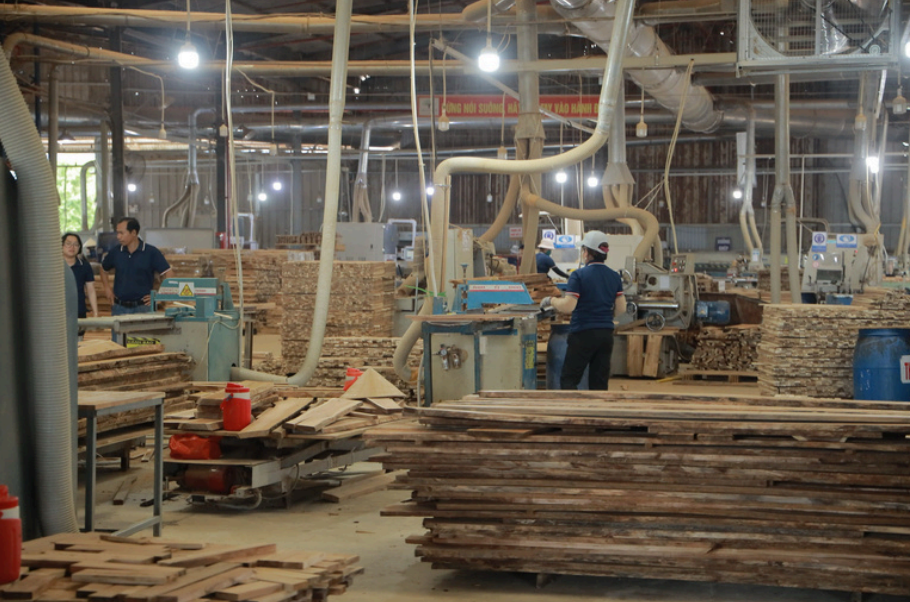 Material Yield & Biomass Energy
Cutting Yield Optimization & Circular Biomass
Computer-aided nesting and gang-rip optimization achieve typical cutting yields of 75%–82% based on lumber grade and component specs. Solid hardwood offcuts are reclaimed for finger-joint furniture components, while clean sawdust and shavings fuel on-site biomass steam boilers for timber drying kilns.
 Finishing Reclamation & Waste Stewardship
Powder Reclamation & Compliant Waste Handling
Powder coating lines utilize cyclone reclamation booths to capture overspray powder and minimize chemical waste. Export packaging uses recyclable corrugated cartons meeting specified burst tests. Finishing effluents and hazardous wastes are transferred exclusively via licensed industrial waste management contractors.
Sustainability Claims & Source Verification Matrix
Comprehensive breakdown of the 6 sustainability activities, operational baselines, facility scopes, and verification source dossiers
| Activity / Pillar | Operational Practice & Measured Metric | Facility & Programme Scope | Verification Source / Due Diligence Dossier |
|---|---|---|---|
Timber Sourcing & Traceability | 100% of timber inputs are FSC-certified; complete chain of custody maintained from certified plantation concession through primary breakdown and kiln-drying. | All wood furniture production lines at nominated facilities (Binh Duong, Quy Nhon, Dong Nai clusters). | Facility FSC CoC Certificate, VAT Purchase Invoices, Forest Department Transport Manifests, and Kiln Batch Logs. |
Cutting Yield Optimization | Computer-aided nesting and precision gang-ripping yielding 75%–82% recovery baseline depending on lumber grade, moisture profile, and component geometry. | Primary breakdown and rough mill workshops handling solid timber (Acacia, Eucalyptus, Teak). | Technical Bill of Materials (BOM), Shift Yield Performance Logs, and ERP Material Utilization Summaries. |
Solid Wood Offcuts Repurposing | Clean hardwood offcuts sorted by dimension, planed 4-sides, and fed into finger-jointing lines or edge-glued blocks for concealed structural components. | Secondary conversion lines at designated timber processing and auxiliary component facilities. | Semi-finished lumber sorting SOP and Finger-joint Work Orders. |
Sawdust & Biomass Energy | 100% of clean sawdust and wood shavings captured via central dust extraction cyclones and utilized on-site as carbon-neutral biomass fuel for kiln boilers. | Central dust collection systems and boiler facilities at designated primary wood processing sites. | Boiler Fuel Feed Logbooks, Kiln Steam Generation Records, and Industrial Boiler Safety Permits. |
Powder Coating & Packaging Recycling | Cyclone recovery booths recycle clean powder overspray; export shipping cartons utilize 5-ply / 7-ply recyclable corrugated board compliant with buyer ECT standards. | Metal finishing workshops and export packing lines for contracted programme orders. | Powder Coating Technical Datasheets, Packaging Material Inspection Reports, and Box Compression Certificates. |
Industrial Waste & Hazardous Handling | Hazardous process wastes (paint sludge, oily shop rags, spent solvent drums) stored in dedicated bunded hazardous stores and transferred by licensed contractors. | Designated hazardous waste storage facilities across active manufacturing sites. | Hazardous Waste Source Registration, Environmental Monitoring Reports, and Licensed Waste Transfer Manifests. |
Timber Sourcing & Traceability
100% of timber inputs are FSC-certified; complete chain of custody maintained from certified plantation concession through primary breakdown and kiln-drying.
All wood furniture production lines at nominated facilities (Binh Duong, Quy Nhon, Dong Nai clusters).
Facility FSC CoC Certificate, VAT Purchase Invoices, Forest Department Transport Manifests, and Kiln Batch Logs.
Cutting Yield Optimization
Computer-aided nesting and precision gang-ripping yielding 75%–82% recovery baseline depending on lumber grade, moisture profile, and component geometry.
Primary breakdown and rough mill workshops handling solid timber (Acacia, Eucalyptus, Teak).
Technical Bill of Materials (BOM), Shift Yield Performance Logs, and ERP Material Utilization Summaries.
Solid Wood Offcuts Repurposing
Clean hardwood offcuts sorted by dimension, planed 4-sides, and fed into finger-jointing lines or edge-glued blocks for concealed structural components.
Secondary conversion lines at designated timber processing and auxiliary component facilities.
Semi-finished lumber sorting SOP and Finger-joint Work Orders.
Sawdust & Biomass Energy
100% of clean sawdust and wood shavings captured via central dust extraction cyclones and utilized on-site as carbon-neutral biomass fuel for kiln boilers.
Central dust collection systems and boiler facilities at designated primary wood processing sites.
Boiler Fuel Feed Logbooks, Kiln Steam Generation Records, and Industrial Boiler Safety Permits.
Powder Coating & Packaging Recycling
Cyclone recovery booths recycle clean powder overspray; export shipping cartons utilize 5-ply / 7-ply recyclable corrugated board compliant with buyer ECT standards.
Metal finishing workshops and export packing lines for contracted programme orders.
Powder Coating Technical Datasheets, Packaging Material Inspection Reports, and Box Compression Certificates.
Industrial Waste & Hazardous Handling
Hazardous process wastes (paint sludge, oily shop rags, spent solvent drums) stored in dedicated bunded hazardous stores and transferred by licensed contractors.
Designated hazardous waste storage facilities across active manufacturing sites.
Hazardous Waste Source Registration, Environmental Monitoring Reports, and Licensed Waste Transfer Manifests.
Site-Specific Audits & Chain of Custody
Certifications including FSC CoC, ISO 9001, ISO 14001, BSCI, and SMETA are site-specific. Documented audit reports and valid scopes for the nominated production facility are provided directly to qualified buyers during programme onboarding.